

Congrats on getting your PhD, douchebag. We'll miss you. May life in industry be full of excitement and mystery.
Tuesday, April 21, 2009
Great Douchebags of Science: Caleb Kennedy


Monday, April 20, 2009

Sunday, April 19, 2009
Demystifying DNA electrophoresis
One of my goals for our blog is to show (to the few people who may read this who don't know us personally) that scientists are just like regular people whose job happens to be mixing together clear liquids all day. For this reason, I am pretty interested in DIYbio, a group that aims to make science, and biology in particular, more accessible to people who are interested in viewing the world around them scientifically but maybe don't have a degree in science. [What follows is probably the most serious/boring post we have on here, but believe it or not, we are serious sometimes and this is something I feel is important enough to go into excruciating detail about. Feel free to skip this and go back to looking up cusses in scholarly journals.]
I think it is totally awesome that people who don't have a lot of experience with science think that biology is cool enough to meet at bars to talk about, and it is great that people want to do experiments. However, in the process of demystifying biology so that amateurs can interact with things like bacteria, DNA, and even genomes, DIYbio often ends up pushing "traditional" science further into the abstract ivory tower. This is especially true I think in the discussions around how to do DNA electrophoresis (separating different pieces of DNA based on their size). In seeing what DIYbio is proposing as methods for doing this common lab technique, it is clear that the people who do it every day (grad students, post docs, and technicians working in labs everywhere) haven't done a really good job of explaining how the data that is finally presented to the public is "made"; that is, how the experiments are actually done. What people end up seeing is what biotech companies that want you to buy their $1000+ electrophoresis setups are saying.
I hope that in showing how we do DNA electrophoresis in our lab (at the ivoriest of all towers, harvard) I can show how experimental biology is often hacked together and DIY (which makes it really fun and sometimes frustrating) and has a lot more to offer than the final reports of what we make of the experimental results, and way more to offer than the bio-rad website. I'm not going to go through all of the DIYbio proposals on how to do gels, because the discussion boards listed above already go into good detail about what would work and what wouldn't and why. My goal is just to show that the way that we do it is already pretty cheap and is actually quite similar to some of the final proposals for the DIY gel box from Pearl Biotech.
So here's my method for making DNA gels, illustrated with some fancy cell phone camerawork. First, I weigh out some agarose, mix it with saline, and microwave it for two minutes. Agarose is relatively expensive at $420 for 500 grams, but you only need 1 gram per gel so it should last for a long time.
While the agarose is microwaving I put together my gel tray. We use a simple piece of plastic put together for us by the harvard machine shop wrapped with masking tape (really) around the bottom so that the melted agarose doesn't fall out. A small plastic comb makes the wells where I'll put the DNA.

Now my agarose is melted, and here comes the tricky part. We add ethidium bromide here, a super toxic, absolutely (maybe) will kill you DNA stain that allows us to see where the DNA is. This stuff is difficult to dispose of safely, and there are some other options for DNA stains that are more expensive, but probably better if you're going to be doing this someplace that doesn't have OSHA people all over it. 
Now I've poured my gel into my prepared gel tray and let it harden, it's time to load my DNA.

I put it into a plastic box, also made by the machine shop. This box is filled with the same saline solution I used to dissolve my agar, and has a wire running through it that can be connected to any power source. I mix the DNA with a solution of glycerol and a dye. The dye lets you see how far your sample has run through the gel, and the glycerol is heavier than water so it lets the DNA fall into the wells that the comb made in the gel.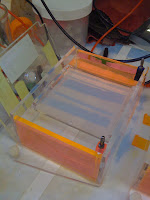

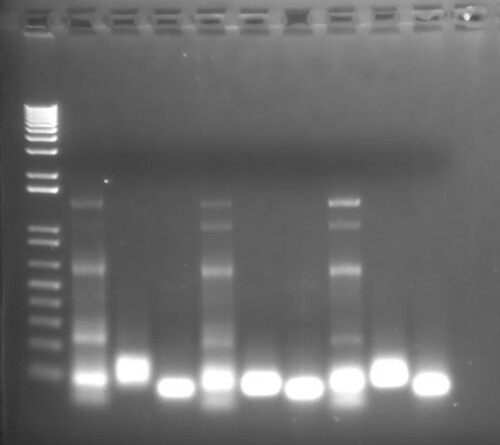
After running a voltage through the gel for about 20 minutes the gel is ready to look at under UV light. This makes the ethidium bromide glow where it has bound to the DNA and you can take a picture of the gel.
Tada! I hope that this shows that lab scientists and home scientists have a lot in common when we have similar goals, in this case separating out some DNA. I think if what people saw about DNA wasn't on CSI, Gattaca-like tests that gave you statistically suspect percentages for disease risk, or $500 canvases with DNA fingerprints that people wouldn't think scientists are so weird, and maybe would be even more interested in talking about biology at a bar. If you think this is a good idea, let us know. If you think it's boring, let us know; we can go back to talking about Star Trek and poop.
Sunday, April 12, 2009
Numerical Analysis of Profanity in the PubMed Database
Here at UotH headquarters, we are primarily concerned with bringing about the Hydrocalypse and self-aggrandizement. In order to continue receiving our government welfare stipend checks, however, we must occasionally do research. As Systems Biologists, this means we spend as much time on the computer as possible trying to avoid doing actual experiments. This often means looking at data that other people collected and pulling conclusions out of a hat. As an example, we present an analysis of profanity in the PubMed database.
PubMed is a massive database curated by the NIH that contains most articles written this century on biology and medicine. It is also full of swears:

This is a good first pass at the data, but we know that power law distributions are all the rage these days, so we need to make the data look more power-law-y. Randomly adding parameters to our model revealed a missing parameter that completes our graph:

Much better. A thoughtful scientist would want to delve deeper into the data to discover the mechanisms through which swears end up on PubMed. Running a hidden-Markov chain model on the data classified the causes of bad words on PubMed into the following categories:
1. Snarky scientists
"Poop" is a prime offender for this one, as evidenced by the following titles of actual papers on PubMed:
Using cutesy terms in articles about dysfunctionally defecating babies is something we approve.
2. Poor abbreviation choices
The study of the metabolism of fucose has lead to awesomest group of genes in the history of biology: the "fuc" genes. As is tradition in the identification of E. coli genes, each gene in a pathway gets a four letter name, leading to fucA, fucB, fucC...all the way to the #1 gene of all time: fucK, which as everyone knows encodes the enzyme L-fuculokinase. As expected, this leads to some great papers, like this one:
A mutant crp allele that differentially activates the operons of the fuc regulon in Escherichia coli.
Department of Microbiology and Molecular Genetics, Harvard Medical School, Boston, Massachusetts 02115.
L-Fucose is used by Escherichia coli through an inducible pathway mediated by a fucP-encoded permease, a fucI-encoded isomerase, a fucK-encoded kinase, and a fucA-encoded aldolase. The adolase catalyzes the formation of dihydroxyacetone phosphate and L-lactaldehyde. Anaerobically, lactaldehyde is converted by a fucO-encoded oxidoreductase to L-1,2-propanediol, which is excreted. The fuc genes belong to a regulon comprising four linked operons: fucO, fucA, fucPIK, and fucR. The positive regulator encoded by fucR responds to fuculose 1-phosphate as the effector. Mutants serially selected for aerobic growth on propanediol became constitutive in fucO and fucA [fucO(Con) fucA(Con)], but noninducible in fucPIK [fucPIK(Non)]. An external suppressor mutation that restored growth on fucose caused constitutive expression of fucPIK. Results from this study indicate that this suppressor mutation occurred in crp, which encodes the cyclic AMP-binding (or receptor) protein. When the suppressor allele (crp-201) was transduced into wild-type strains, the recipient became fucose negative and fucose sensitive (with glycerol as the carbon and energy source) because of impaired expression of fucA. The fucPIK operon became hyperinducible. The growth rate on maltose was significantly reduced, but growth on L-rhamnose, D-galactose, L-arabinose, glycerol, or glycerol 3-phosphate was close to normal. Lysogenization of fuc+ crp-201 cells by a lambda bacteriophage bearing crp+ restored normal growth ability on fucose. In contrast, lysogenization of [fucO(Con)fucA(Con)fucPIK(Non)crp-201] cells by the same phage retarded their growth on fucose.
This paper received extra points for remarking that growth on fucose is "retarded."
3. Unfortunate language issues
Many scientific papers are written in english by scientists who don't primarily speak english. As ugly Americans, we feel free to mock these papers. It appears that "bitch" is a favorite in this category, as female dog research seems to be popular overseas. Our old friend "poop" again makes an appearance in this category, along with his PG-13 friend, "shit":
Of course, defunctionalized poop is no laughing matter, but farts are always funny:
Automatic analysis of signals with symbolic content.
Department of Applied Physics, University of La Laguna, C/ Astrofísico Sánchez. Ed. de Física y Matemáticas, CP 38200, La Laguna, Spain.
This paper presents a set of methods for helping in the analysis of signals with particular features that admit a symbolic description. The methodology is based on a general discrete model for a symbolic processing subsystem, which is fuzzyfied by means of a fuzzy inference system. In this framework a number of design problems have been approached. The curse of dimensionality problem and the specification of adequate membership functions are the main ones. In addition, other strategies, which make the design process simpler and more robust, are introduced. Their goals are automating the production of the rule base of the fuzzy system and composing complex systems from simpler subsystems under symbolic constrains. These techniques are applied to the analysis of wakefulness episodes in the sleep EEG. In order to solve the practical difficulty of finding remarkable situations from the outputs of the symbolic subsystems an unsupervised adaptive learning technique (FART network) has been applied.
We couldn't gain access to the actual paper for this one, so we took the liberty of reconstructing what the FART network looks like:
 As you can see, the FART network is also scale-free.
4. Funny last names
Amazingly, despite the breakthroughs in fuc research, many of the papers that appear on a PubMed search for "fuck" are written by scientists with the last name of "Fuck." Since we've never seen ads for Fuck family reunions around these parts, we're guessing that this is also a language issue.
5. BONUS: In rare cases, multiple swears end up in a single paper. The preponderance of Dr. Fucks, combined with the important bitch research being conducted throughout the world, has lead to a single paper:
Ovarian teratoma in a bitch.
Department of Preventive Veterinary Medicine, Universidade Estadual de Landline, Londrina, Paraná 86051-990, Brazil.
Scientific writing doesn't often inspire poetry, but this paper is beautiful in its simplicity and directness. Feel free to recite this at your next poetry slam:
Ovarian teratoma in a bitch.
Fuck. Fuck.
Tuesday, March 24, 2009
Sassy Bitches of Science: Happy Ada Lovelace Day!
Today is Ada Lovelace Day, where the internet celebrates all the Sassy Bitches of Technology.
All over the internet there are awesome blog posts about sassy bitches doing their part for science and technology, including my new favorite, the awesomely sassy Grace Murray Hopper:
Have a sassy day everyone, and get ready for Sassy Bitches of Science: Rosalind Franklin--coming soon!
Friday, March 20, 2009
Evolution in a Can
If you only saw this blog, you would think that we spend most of our time thinking about television and getting famous. While this is true, we also spend a lot of time thinking about science and how to bring the hydrocalypse. Most of our work focuses on trying to artificially evolve hydrogen-producing enzymes to be stronger. Another huge area of effort is coming up with acronyms. For example, this artificial evolution strategy is referred to as the "Hydrogenase Isolating Life-form: A Novel Directed Evolution Reactor," or:
There can be only one.
Tuesday, March 17, 2009
Creating a sitcom based on the lab step 1: casting
For our new sitcom "The Lab," we decided to start with casting and go from there. There's a lot of people in the lab, so we started with the people in the two bays that house the bloggers, the boss, and people we constantly make fun of.
First, the boss-
The bloggers-


The baymates-

And our good friends who have a good sense of humor when we make jokes about them-

Please pass this along to any friends in the industry!
Subscribe to:
Posts (Atom)


